Maasvlakte II Newsletter February 2026
Strengthening the chain together – Looking back and looking ahead
2025 was a year in which the strength of our collaboration within the supply chain once again clearly came to the fore. On both the seaside and landside, we processed significantly higher volumes together. By better clustering volumes within the chain and working closely together, we were able to operate with larger call sizes and use our capacity efficiently.
These results would not have been possible without the close cooperation with the hinterland and our supply chain partners. Thanks to joint alignment, flexibility, and mutual trust, we were able to handle the increased volumes while maintaining the service levels you have come to expect from us. This is something we can rightfully pause to appreciate at this time of year.
At the same time, we are noticing that growth is bringing us closer to the limits of the current terminal. Available buffer capacity has decreased, meaning that in the event of incidental disruptions, it sometimes takes longer to fully restore operations. It is precisely in those moments that the importance of understanding, clear communication, and collaboration within the chain becomes evident.
In 2026, our expansion is also drawing ever closer. A major milestone, which requires additional activities and adjustments at the current terminal. In the coming period, we therefore count on everyone’s involvement: by thinking along with us, remaining extra alert, and showing flexibility. Together, we will ensure that this transition runs smoothly.
We are heading into a challenging year, but also a year full of opportunities — a year in which we truly need each other to keep the supply chain strong and reliable.
We would like to thank you, as a valued customer and partner, for your continued trust. We look forward to further optimizing the supply chain together in the year ahead. Should you have any questions following this newsletter, please feel free to contact us.
How well were you served last month?
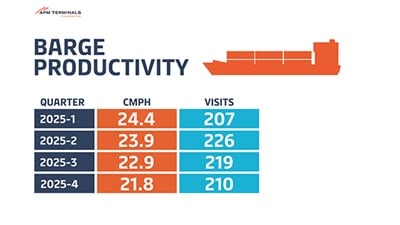
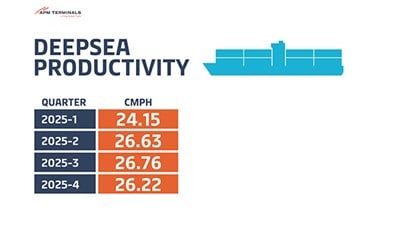
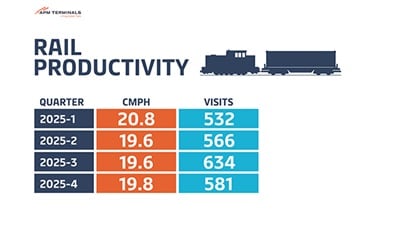
KPI stands for Key Performance Indicators, also referred to as critical success factors. These indicators show how successfully APM Terminals Maasvlakte II is currently performing. Below, we share the terminal figures for 2025 per quarter. The abbreviation CMPH means ‘Crane Moves Per Hour’.
|
|
|
|
|
|
Higher volumes lead to more activity in our truck handling
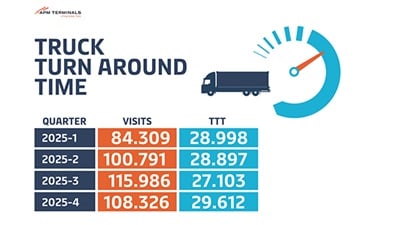
In 2025, we saw strong growth in volumes. Over the course of the year, we achieved record numbers, with more than 400,000 gate operations. This growth reinforces confidence in our services but also brought additional pressure to our daily operations.
We understand that higher workloads can sometimes slow down operations, leading to potential delays and increased time pressure. Operations are often carried out according to tight schedules and interdependencies, where every minute counts.
Particularly in Q4, the Truck Turnaround Time was higher than desired. This was caused by the combination of increased volumes and a technical issue, which temporarily affected processing times. The issue has now been resolved, and additional measures have improved stability and predictability in the process.
At the same time, in 2025 we took important steps to further enhance our reliability. On a technical, operational, and communication level, we will continue to take steps in 2026 to make the process more stable and predictable — for you and for all parties involved in the chain.
Due to ongoing high volumes, we are also required to manage last-minute cancellations and no-shows more strictly. We understand that this is sometimes beyond your control, but a consistent approach is necessary to keep the process fair, predictable, and manageable for everyone.
It is also important to maintain professionalism and courtesy, even in busy or challenging situations. Only together can we ensure smooth operations and a strong foundation for further growth.
Step by step toward the future
The expansion of APM Terminals Maasvlakte II is well underway. What once started as an ambitious plan is now increasingly taking shape.
Greenfield Progress: key milestones on the expansion site
At the end of October, an important milestone was reached on the expansion site with the placement of the 500th container plinth in the new stack area. These plinths are incorporated into the design as a foundation for containers and to prevent ground settlement over the years. They help ensure that containers remain level.
At the deep-sea quay, the first 250 meters of SQC rails have been installed. Early next year, the first ZPMC ship-to-shore cranes will be placed on these rails. In addition, the new Kuenz ARMGs were successfully assembled and erected in September.
Preparations for the introduction of Automated Terminal Trucks
Within the expansion project, significant efforts are being made to introduce Automated Terminal Trucks (ATTs). These vehicles will play an important role in the automated transport between the rail terminal and the stacks.

Currently, five ATTs are operating on our terminal, and the test results are positive. During these tests, we are working in a mixed traffic environment to assess how different types of vehicles can operate together safely and efficiently. At the rail terminal, a dedicated area has been closed off to conduct tests with the ATT and one of the rail cranes.
Stack 14 has been converted into a test location, where most of the two right-hand lanes are designated for the ATTs. Here, container transfers are being tested between external trucks, manual terminal tractors, and the ATTs.
Truck drivers are expected to behave no differently than in the current situation. It is possible that an ATT may drive slightly slower or be actively maneuvering within the stack lanes.
We kindly ask you to act as you normally would. Thank you in advance for your understanding.
We are committed to providing you with a reliable rail product
A reliable rail product is essential for maintaining a balanced modal split. We still see significant room for improvement in this area. In preparation for the expansion, construction works are currently taking place at our rail terminal, which are impacting capacity.
To make optimal use of the existing capacity, it is important that parties release rail tracks in a timely manner. This helps prevent negative impacts on shared rail capacity and on productivity throughout the supply chain.
Good coordination and timely communication therefore remain crucial to move trains quickly and as agreed, and to keep our services as reliable as possible.
Every day, all involved parties are committed to ensuring the rail process runs as efficiently as possible. By staying alert to agreed arrangements and supporting one another where needed, disruptions can be limited, and the reliability of container deliveries can be further improved.
Behind this reliable rail product are people. Last year, we therefore paid special attention to the Day of the Train Driver. Train drivers are the driving force behind rail freight transport and ensure every day that trains reach their destinations safely and reliably. At our terminal, they are also a familiar presence and form an indispensable link in the logistics chain.
For this special day, we created a short video together with our partner Rail Force One — a great example of how cooperation on and around the railways truly makes a difference.
Change in minimum call size & compliance with house rules for safe barge operations
Barge volumes have increased significantly this year. We appreciate the valuable feedback received through the customer satisfaction survey. One of the main points raised was waiting times. To keep these manageable and continue to ensure our operational performance, further collaboration is essential.
Change in minimum call size
From 1 January 2026, the minimum call size for regular barges will be increased from 15 to 20 moves.
Increasing the call size contributes to:
- higher productivity
- shorter exchange times
- creating additional capacity
With this adjustment, we expect to optimize both planning and execution and to provide you with an improved barge service.
Pilot Barge under SQC: working together towards a more efficient port
We recently launched a pilot for Barges under SQC, with the aim of expanding and further improving barge capacity at our terminal. In the past, handling barges under SQC was a complex process, mainly due to stowage-related constraints. Thanks to the joint efforts of barge operators and all involved parties, we are already seeing the first positive results.
Through this collaboration, equipment can be deployed more effectively, leading to more efficient planning and shorter turnaround times in the port. At the same time, the expanded stowage possibilities allow barges to be handled more flexibly.
This development demonstrates what is possible when parties work together toward a shared goal: a better operation. We remain open to feedback on this topic.
We would like to thank everyone for their cooperation so far. Together, we will continue building toward further optimization.
Safety first - compliance with house rules
In addition to efficiency, safety is always our top priority. Therefore, we would like to once again emphasize the importance of complying with our house rules.

We have observed that barges are increasingly mooring at the new quay in the expansion area of APM Terminals Maasvlakte II. Although the quay and surrounding water area appear to be completed, this infrastructure has not yet been released for use.
- Mooring is only permitted for vessels that have received explicit prior approval from APM Terminals Maasvlakte II.
- Unauthorized use may disrupt operations and pose risks for the supply of materials.
- Vessels must wait their turn at the existing designated berths.
We count on your cooperation to ensure both the safety and continuity of our operations.
Safe and efficient, even in extreme weather conditions
In November, storm Benjamin swept across our terminal with full force. With wind gusts far exceeding operational limits, we prioritized the safety of our colleagues and customers, as always. To avoid risks, we temporarily halted operations. As soon as conditions allowed, we restarted in a controlled and safe manner.
In the video below, one of our colleagues clearly shows the impact that weather can have on our work and how our teams work together to ensure that everything runs safely and efficiently, even under challenging conditions.